
Vibe marketing in 2026: the complete strategy guide
Vibe marketing is the AI-assisted practice of building emotional resonance through brand expression, cultural alignment, and authentic storytelling. Unlike traditional marketing, it prioritizes how audiences feel over product features. Search interest surged 686% in 2025, with 47% of Fortune 500 companies now using it as a core growth strategy.
Key takeaways
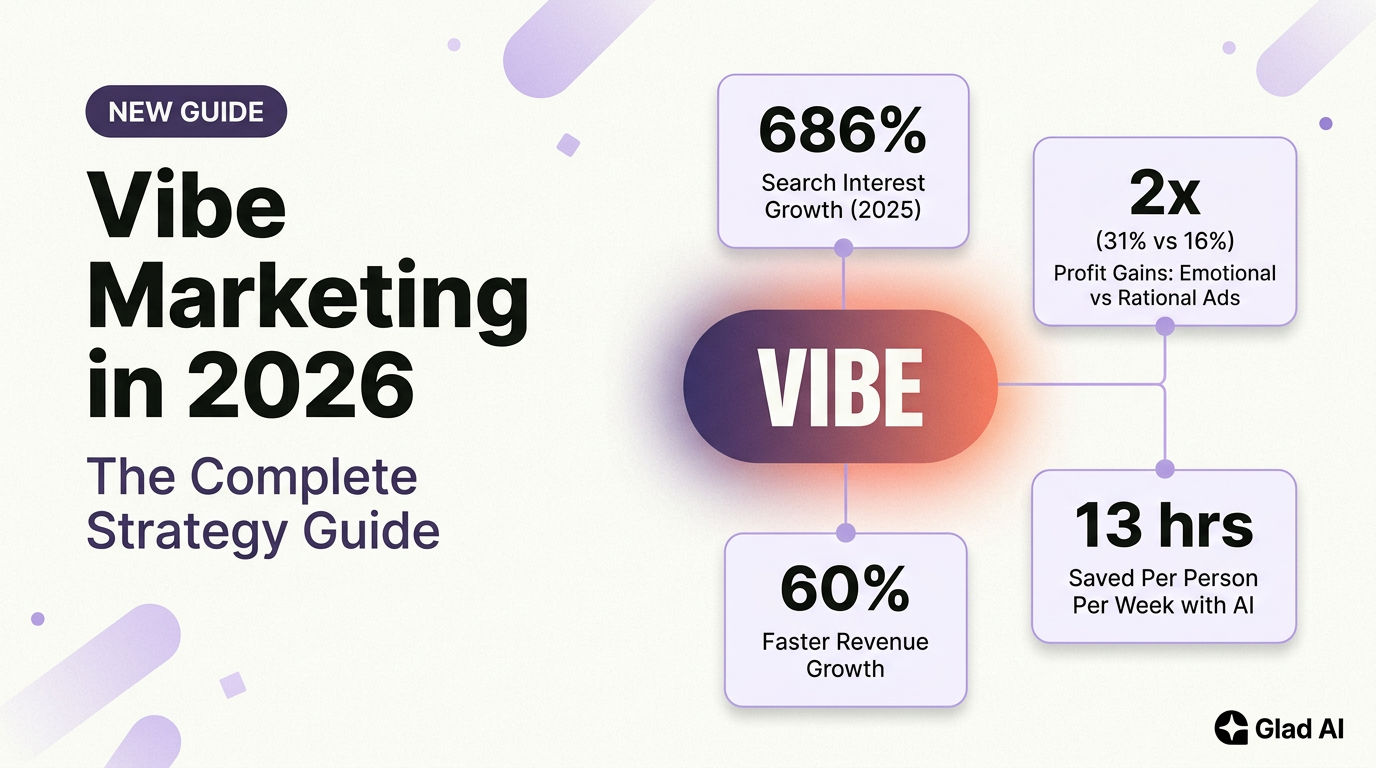
- Searches for "vibe marketing" grew 686% in 2025. This is not a niche trend. It is the operating model for modern brand communication.
- Purely emotional ad content drives twice the profit gains of rational-only content: 31% vs 16% (Amra and Elma, 2025).
- Personalized vibe-driven campaigns produce 60% faster revenue growth than traditional strategies (DemandSage, 2025).
- Over 50% of LinkedIn long-form posts in 2025 were likely AI-generated. The platform now actively penalizes generic AI patterns.
- Consistent brand voice across channels can increase revenue by up to 23% (Lucidpress).
- AI tools save an average of 13 hours per person per week — roughly one-third of the working week (VibeMarketing.ninja, 2025).
What is vibe marketing?
You are watching the marketing industry catch up to something consumers already knew: features do not build loyalty. Feelings do.
Vibe marketing is the AI-assisted practice of shaping brand expression through emotional tone, cultural alignment, and authentic storytelling. It does not start with "who is our target demographic." It starts with "how do we want people to feel?"
The term drew direct inspiration from "vibe coding," a concept introduced by OpenAI co-founder Andrej Karpathy in early 2025 to describe a prompt-first, AI-driven approach to software development. Vibe marketing is its brand communication counterpart: describe the emotional signature you want, build content around it, test variations fast, and repeat.
VIBE is also an operational acronym used by practitioners:
- V — Velocity. Moving at the speed of culture, not legacy production cycles.
- I — Identity. Designing for who customers aspire to become, not just their current needs.
- B — Boundaryless. Breaking down the walls between creative, data, and strategy teams.
- E — Emotions First. Prioritizing feeling over feature lists in every piece of content.
Here is the thing. This is not abstract philosophy. Searches for "vibe marketing" grew 686% in 12 months. As of Q3 2025, 47% of Fortune 500 companies have adopted vibe marketing elements. Startups on Y Combinator are hiring vibe marketers at compensation reaching seven figures (DemandSage, 2025).
That is a strong signal about where the market is moving.
From vibe coding to vibe marketing: how the concept evolved
Before vibe marketing, there was vibe coding. The idea was simple and radical: instead of writing explicit code, describe what you want in plain language and let AI handle the implementation. Intent replaces syntax.
Brand teams noticed the same principle could apply to content. Instead of laboring over exact copy, you define the emotional territory you want to occupy, feed it to AI tools, and iterate at speed.
The result was a compression of campaign timelines from weeks to hours. A skincare brand no longer needs four weeks of market research and copy approval cycles to respond to a cultural moment. AI tools now test emotional content variations within 48 hours and surface what resonates in real time. Some teams add a pre-publish layer using synthetic audience platforms like Replism to preview how specific segments will react before any creative goes live, then refine the emotional signal based on simulated response.
That agility is the core competitive advantage. Oreo's now-famous "You can still dunk in the dark" tweet during the 2013 Super Bowl power outage took a war room of creatives. Today, a single founder with the right setup can execute that kind of moment-marketing solo.
Vibe marketing vs. traditional marketing
Traditional marketing is not dead. But it is slow, feature-focused, and increasingly expensive relative to its reach. Vibe marketing does not need to replace it entirely. It just needs to change how you think about what leads the conversation.
| Aspect | Traditional marketing | Vibe marketing |
|---|---|---|
| Campaign cycle | 3-4 weeks for research and launch | 48 hours for creation and testing |
| Core focus | Product features and specifications | Emotional resonance and experience |
| Success metrics | Conversion rate, cost-per-acquisition | Engagement depth, sentiment, brand affinity |
| Team requirement | Specialized departments and large budgets | One person with AI tools and a clear brand voice |
| Revenue impact | Baseline | Personalized vibe campaigns: 60% faster growth (DemandSage, 2025) |
The math is not complicated. Purely emotional ad content performs twice as well as rational-only content in driving high profit gains: 31% versus 16% (Amra and Elma, 2025). Emotional marketing campaigns produce a 23% potential sales increase when ads trigger above-average emotional responses.
And 71% of customers recommend a brand specifically because of emotional connection, not product superiority (PassiveSecrets, 2025).
The brand with the bigger budget used to win. Now the brand with the clearer emotional signal wins. That is the real shift.
The 4 core principles of vibe marketing
1. Emotional resonance
The content that sticks is not the most informative. It is the most felt.
Emotional resonance means crafting content that triggers genuine feelings. Joy, nostalgia, validation, inspiration. Not in a manipulative way. In a "you get me" way that turns a first-time visitor into someone who shares your content in their private Slack channels.
Research confirms it: 70% of consumers are more likely to buy after being emotionally triggered by an ad. 82% of highly emotionally engaged consumers are brand loyal. And emotionally connected customers are three times more likely to promote products without being asked (PassiveSecrets, 2025).
2. Cultural relevance
Being culturally relevant does not mean chasing every trend. That is the fastest way to look desperate.
Cultural relevance means filtering cultural signals through your existing brand identity. A fintech brand posting about astrology does not create connection. It creates confusion. Adopt what aligns. Ignore the rest.
Poppi built a $700M brand by making probiotic soda a Gen Z identity statement, not a health product. Gymshark built a global community by celebrating fitness diversity instead of pushing aspirational aesthetics. Both brands moved at the speed of culture without losing their core identity (Harris Poll, 2025).
3. Authenticity
Audiences in 2026 have spent years inside AI-saturated feeds. They know what generic looks like. They clock it in about two seconds.
47% of Gen Z consumers say a brand advertising around an unrelated cause is no more than a sales ploy (From Day One, 2025). 92% say the community around a brand directly affects how they feel about it (Sprout Social Index, 2025). Over 50% of LinkedIn long-form posts in 2025 were flagged as likely AI-generated, and human-written posts consistently outperformed them on engagement (Originality.AI, 2026).
Authenticity is not about being unpolished. It is about being real.
4. Brand vibe consistency
Consistent brand presentation across all channels can increase revenue by up to 23% (Lucidpress). 68% of companies report 10-20% revenue growth directly attributable to brand consistency (Amra and Elma, 2025).
The emotional signal your LinkedIn post sends has to match what someone feels when they land on your homepage. When those experiences conflict, trust erodes. Rinse. Repeat.
How startups can compete on a lean budget
The playing field has leveled. Not because everyone got bigger budgets. Because AI tools made emotional clarity more accessible than spending power.
Here is the truth. A startup's authenticity now resonates more powerfully than a corporate brand's polished campaign. Agility and a clear emotional identity outcompete slow, committee-approved messaging every time.
The numbers back this. AI tools save an average of 13 hours per person per week, roughly one-third of a 40-hour workweek (VibeMarketing.ninja, 2025). 68% of businesses reported content marketing ROI growth after deploying AI tools (McKinsey, 2025). The AI marketing market is already valued at $47.32 billion in 2025 and is growing at 36.6% annually (Averi AI, 2025).
88% of marketers now use AI tools daily. Three years ago that number was near zero.
The companies winning today are not the ones with the biggest teams. They are the ones moving fastest, with a consistent emotional identity and the tools to execute it without six-person approval chains.
Tools and technologies driving the vibe marketing shift
The right tech stack converts an abstract brand feeling into concrete, automated output. Here is how the stack breaks down.
AI content generation
The core layer. Platforms that learn your voice from existing content, generate brand-consistent posts, and test emotional variations without requiring you to stare at a blank page. The important distinction: a tool that applies a generic template is not voice-consistent AI. A tool that reads your website, your existing posts, and your writing patterns before generating a single word — that is the difference between sounding like a robot and sounding like yourself.
No-code automation
Workflow builders like Make, n8n, and Zapier connect thousands of apps. You build a publishing pipeline, a sentiment monitoring workflow, or a lead nurture sequence in hours. No engineering required. Platforms like Taskade offer over 700 automated tasks operable through natural language prompts.
CRM and sentiment analysis
CRM integration ensures every customer touchpoint maintains a consistent emotional tone. AI-powered CRMs now track sentiment alongside traditional sales metrics, showing you not just what customers say but how they feel.
Visual and design tools
Canva's AI features, Adobe Firefly, and HeyGen let small teams produce professional-grade visual and video content. AI-generated campaigns now cost under $100 and launch in 24 hours. Traditional campaigns cost $5,000-$20,000 and take three weeks (VibeMarketing.ninja, 2025). Video marketers using AI tools see 82% higher ROI compared to traditional video production.
LinkedIn automation without losing your voice
Here is the problem most founders discover around week three of their LinkedIn AI experiment. The posts look fine. They are grammatically correct, they hit the right topics. But they do not sound like them. And the audience can tell.
LinkedIn's 2026 algorithm is not passive about this. It actively detects AI-generated patterns and suppresses content flagged as generic. The platform now explicitly rewards "obviously human" signals — creator authenticity, dwell time, and initial engagement quality in the first 60 minutes (GrowLeads, 2026).
The context makes this urgent. Over 50% of long-form LinkedIn posts in 2025 were likely AI-generated, creating a quality saturation problem (Originality.AI, 2026). There has been a 189% increase in AI-generated posts since ChatGPT launched. Humans have gotten good at scrolling past the generic wrappers.
At the same time, a personal LinkedIn profile drives 2.75x more impressions and 5x more engagement than a company page (Snov.io, 2025). The individual voice is the asset. The question is how to scale it without destroying it.
The right approach to voice-consistent automation
The difference is in how the tool learns. A scheduler is not the same as a voice engine. A tool that reads your website, scrapes your blog, and analyzes your existing posts before producing a single piece of content is not the same as a tool that takes a prompt and runs a template.
56% of professionals struggle to maintain their personal voice when using AI content tools (AmpliAI, 2025). That is the problem Glad AI's Voice Consistency Engine is built to solve. It does not just schedule posts. It learns your specific communication patterns so every automated message feels personally written by you, not a one-size-fits-all output.
Smart automation also knows when to pause. High-value replies and relationship-building moments flag for human intervention rather than a canned response. You save hours weekly while keeping the personal touch that drives replies.
Building consistent brand voice across platforms
Voice consistency is not a style guide. A style guide tells your team what words to use. Voice consistency is the felt experience of your brand from every touchpoint — a social post, a sales email, a customer support reply — carrying the same energy.
| Element | Traditional approach | Vibe-driven approach |
|---|---|---|
| Core focus | Promoting product features | Building emotional connection |
| Content creation | Lengthy revisions and "make it sound like us" loops | Streamlined by a defined emotional signature |
| Platform adaptation | Separate strategies for each channel | Unified tone with format adjustments |
| Customer perception | Sees a seller | Feels a community member |
The revenue data is clear. Consistent branding across all channels can increase revenue by up to 23% (Lucidpress). 79% of consumers are more loyal to brands with consistent communication across departments (CapitalOneShopping, 2025). 91% of consumers say they reward brand authenticity with a purchase (Cropink, 2025).
This is what the blank-page problem costs you in practice. Every inconsistent post, every off-brand reply, every "we ran out of ideas this week" gap in your publishing schedule is a withdrawal from your brand's emotional trust account.
Creating content with emotional resonance
Emotional storytelling transforms dry facts into content people share in their private chats. Not their public feeds. Their private ones. That is the signal that something actually landed.
The content funnel, re-framed for vibe
Top-of-funnel content should emit an emotional signal that reflects your ideal customer's identity. Not "here is what we do." More like "here is who you are if you work with us."
Middle-funnel content connects that feeling to real product value. Through use cases, customer stories, and behind-the-scenes transparency. Not through feature comparisons.
Bottom-of-funnel content should carry the same energy as everything above it. Onboarding copy, signup flows, welcome emails — these are not dead zones. They are the moment a new customer decides whether the brand lived up to its emotional promise.
What to measure
Vanity metrics — likes and follower counts — do not tell you if emotional resonance is working. Look instead at:
- Saves and shares to private channels (people do this with content that represents their identity)
- Comments that reference how someone felt, not just what they thought
- Customers citing the brand's "vibe" or "feel" as a reason for signing up
- Dwell time on content pages
- Positive sentiment score trends in CRM analytics
Social media and visual consistency
Your visual identity communicates before your copy does. In a user's feed, color and design make the first impression in milliseconds.
Think of Notion's clean, calm interface versus Liquid Death's irreverent punk energy. Both are precise expressions of brand vibe. Both create instant recognition in a scroll. Neither works for the other's audience.
Uber and Lyft offer nearly identical services. Their visual identities attracted different user segments entirely. That is vibe at work.
The filter for what trends to adopt is simple: does this align with the emotional signal we have already established? If yes, move fast. If no, ignore it with confidence. Smart marketers filter cultural moments through their existing identity rather than chasing every wave.
Brands with consistent visual identity across platforms get up to 80% better brand recognition (multiple sources, 2025). That is not a design preference. That is a compounding business advantage.
Data, sentiment analysis, and measurement
Vibe marketing is not anti-data. It is pro-different-data.
Traditional metrics measure what people did. Emotional metrics measure what people felt and what they were moved to do because of it. The difference between a 2.6% average conversion rate and a campaign that builds the kind of trust where customers refer before they even convert.
Track time spent with content alongside click-through rates. Layer sentiment analysis from social listening tools onto your standard CRM reporting. Set specific KPIs for your target emotional signature: positive sentiment ratio, share rate, and comment quality scores.
AI-powered CRM systems now monitor these indicators continuously, identifying which touchpoints build the most authentic connection at scale. When you integrate this data, you see exactly which emotional approaches drive referrals, repeat purchases, and the customer lifetime value numbers that actually move a business.
Overcoming the common challenges
Measuring emotional ROI for stakeholders
Traditional ROI metrics were not built for emotional marketing. The solution is integration. Connect sentiment data to sales outcomes in your CRM. Track the full customer journey from emotional content touchpoint to conversion. The data exists — it just needs to be assembled differently.
| Common challenge | Smart solution | Key tool or principle |
|---|---|---|
| Measuring emotional ROI | Integrate sentiment data with sales metrics | CRM with analytics integration |
| Consistent tone across touchpoints | Centralized brand voice guidelines and AI-trained templates | Voice Consistency Engine |
| Staying relevant with trends | Timeless positioning with selective cultural adoption | AI for trend monitoring |
| Scaling without sounding generic | AI trained on your specific voice, not templates | Voice-learning AI platforms |
Balancing automation with human touch
Automation handles the consistent, repeatable work with perfect precision. Scheduling, post generation, connection requests, follow-up sequences.
Human judgment handles the moments that matter. A thoughtful reply to a meaningful comment. A decision to go off-script. A real conversation that could become a real relationship.
Configure your AI agents with specific tone parameters trained on your natural language patterns. Know in advance which signals should flag for human response rather than automated follow-up. That balance is what separates automation that builds trust from automation that erodes it.
What comes next
Vibe marketing is not a trend you can schedule for later. The audience has already recalibrated. The algorithm has already adjusted. The AI-saturation problem on LinkedIn is already here.
The brands that will own their categories in 2026 are not the ones with the biggest ad budgets. They are the ones with the clearest emotional signature, the most consistent voice, and the systems to deliver both at scale without losing what made them recognizable in the first place.
Define your core emotional signal. Build the tech stack that scales it authentically. Stop producing content that sounds like it came from a generic wrapper.
The future belongs to brands that people feel. Not just find.